Skip to content

convergence

Unleashing the Bounds of Creativity: How Technology is Changing Art

  • by
Photo: Pexels.com

Guest post by Lucy Wyndham

Science is the seeking of knowledge through facts and unbiased opinions, while art is the application of human creativity and imagination. These two factions are complete opposites that very rarely go hand in hand. Now, modern art is changing that.

Artists are combining the pursuit of science and technology with the expression of creativity to generate art that we have never seen before. Technology is revolutionizing the tools artists can use to create works of art, it’s changing the blank canvas they use to portray their vision, and it’s transforming the way we view, produce, and distribute art.

Read More »Unleashing the Bounds of Creativity: How Technology is Changing Art

How YouTubers are Changing the Job Market

  • by
Image: Pexels.com

Guest post by Lucy Wyndham

The Internet is revolutionizing the way that we do business in multiple sectors, but few markets have been affected as much as the entertainment industry. The rise of online streaming services has increased the number of cord cutters who are choosing to abandon traditional cable in favor of online content. YouTube was one of the earliest hosting and streaming services available to the general public, launching in 2005 and quickly gained popularity among Internet users. Now, more than 50 million YouTubers create content ranging from amateur instructional videos to professionally crafted animations. Here are some of the ways that the rise of the YouTube age is helping lead to a healthier job market for video editors who are hoping to make it in the entertainment industry.

Read More »How YouTubers are Changing the Job Market

Virtual Reality And The Future Of Storytelling

  • by
virtual reality
Photo: Pixabay

“Just so I understand this correctly, it’s possible to experience death in virtual reality. To experience what it’s actually like to die, in the brutalist of ways even. And as our senses develop — touch, smell, things like that — this experience is only going to get more realistic.”

The woman nodded in response. We were sitting across from each other in a large yurt that overlooked the Pacific Ocean, the door flap of the enormous tent making a gentle slapping sound in the wind as six of us sat cross-legged in a circle well past midnight.

The topic: virtual reality and consciousness.

Read More »Virtual Reality And The Future Of Storytelling

Why Digital Marketing Is The Future (And The Future Is Now)

  • by


Is building a product actually easier than marketing the thing? Some would answer yes. Perhaps it depends on what you’ve set out to build. (Yo, anyone?) On one hand, while marketing has become easier due to more methods at our disposal and advanced tools for measuring impact, the holistic idea of “marketing” as a whole does have its challenges.

For one, marketing departments don’t have a template to follow. There are no feature sets, no assigned tasks in Jira, no testing build to see if the features actually work.

That’s not to say that building a quality product isn’t challenging — it’s been reported that  less than 0.01 percent of consumer mobile apps actually find financial success. The argument is then reversed. Is marketing to blame for this unfortunate rate of success?  Perhaps.

Read More »Why Digital Marketing Is The Future (And The Future Is Now)

Data is the new Journal. (2 of 2)

  • by

cyber_c

Social sharing sites like Facebook and Google+ are great for countless reasons. The discovery factor is amplified and quick. We have the ability to catch up and communicate with people easily and on-the-go.

Our social networks, paired alongside various algorithms, place everything in somewhat omnidirectional proportion to our personal interests. Some folks watch the stream of information passively while others can’t help but participate. Frequently. Like a habit that’s hard to break. But habits are usually created because there’s some sort of personal payoff involved. What’s in it here?

Do we participate out of boredom? For entertainment? Documentation? Self-declaration? All of the above?

Read More »Data is the new Journal. (2 of 2)

Data is the new Journal. (part 1)

  • by

I don’t have much room for storage in the small bungalow apartment where I live. I like to tell people that I adhere strictly to a “one in, one out” policy. When something new comes in, something old must go out. This helps to reduces clutter and the accumulation of “things.”

One mainstay that continues to grow is a small collection of boxes. They’re called “memory boxes” as loosely defined by my cryptic writing penned with a black Sharpie.

Read More »Data is the new Journal. (part 1)

Distractions

  • by

Old technology goes digital and digital wants to be old. Steely and cold, virtual buttons and twistable knobs want to be warm and prone to… Read More »Distractions

Thoughts on Geolocation, Privacy, And The Advancement Of Technology

Apple and Google are both being sued under the recent discovery that the iPhone and Android smartphones track users wherever they go. 

Apple stated that they have never tracked users’ locations, but admitted to a bug that inherently collects user data by logging a complete history of travels by way of timestamped latitude and longitude. This week, they announced a software update that prevents the iPhone and iPad from storing these movements.

Read More »Thoughts on Geolocation, Privacy, And The Advancement Of Technology

Call & Response: Rethinking Storytelling in Video

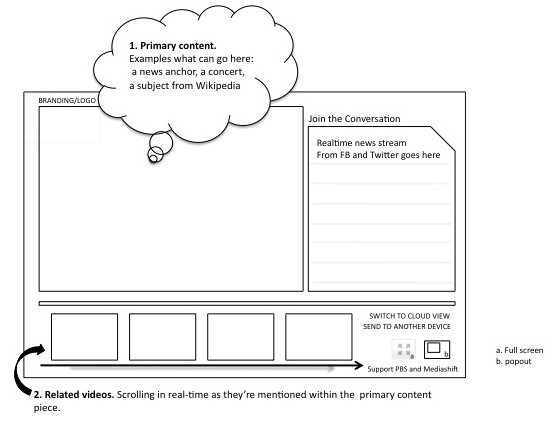
Here are a couple of quick wireframes I mocked up for a really cool contest hosted over at MediaShift’s Idea Lab, in conjunction with The Knight Mozilla News Technology Partnership. These ideas demonstrate how new web video tools can transform storytelling in the news. From APIs to Creative Commons, live-streaming tools to interactive maps, we now have the ability to craft stories in new and compelling ways. And when it comes to video, the opportunities are endless!

Read More »Call & Response: Rethinking Storytelling in Video

Miro and the Enabling of Community Media

  • by

One of my favorite online video platforms to emerge in the last few years is the open-source service Miro.

Formerly known as the Democracy Player, Miro is an Internet tv application developed by the Participatory Culture Foundation.

I’m a big proponent of open-source.  It drives innovation by allowing developers to build on each others’ work,  and makes creating and sharing content easy for everyone (and to support the service, you can adopt a line of code. How clever is that?!).

You can imagine how stoked I was to find out about  Miro Community, an ancillary service created for publishing videos.

Dubbed “The easiest way to make a video website”, Miro Community provides groups like local media organizations and schools with the templates they need to create their own video-based experience.

Read More »Miro and the Enabling of Community Media